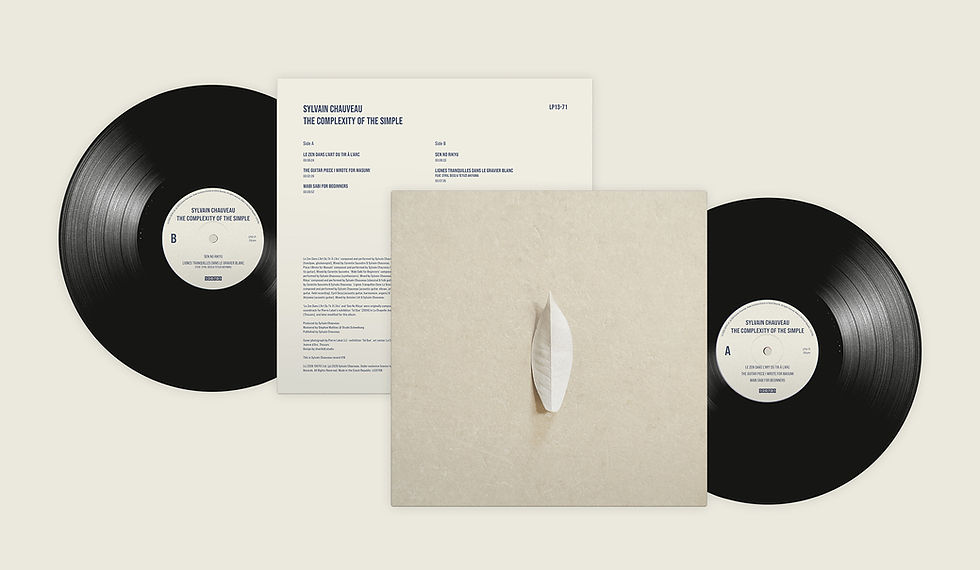
Sylvain Chauveau – The Complexity Of The Simple

Sylvain Chauveau returns to 130701 (FatCat Records’ post-classical imprint) with The Complexity Of The Simple, his sixteenth solo album and a work that distills more than two decades of artistic inquiry into an exploration of restraint, contemplation, and responsibility. Following earlier releases on the label—Un autre décembre (2003) and Simple (2012)—this new collection reaffirms Chauveau’s longstanding commitment to what he has sometimes described as “quiet-core”: a music of reduction, clarity, and attentive listening.
The pieces gathered here were written across nearly a decade, between 2016 and 2025, and assembled and refined in Winter and Spring 2025. Though composed at different times, they converge around two closely linked concerns: an encounter with radical simplicity, and a meditation on the complex future facing music itself.
At the heart of the album lies an experience that shaped Chauveau profoundly. During an artist residency in Kyoto in 2011, he discovered, in a book of Japanese gardens, an image of the Zen garden at Tokaian Temple—an austere rectangle of white gravel marked only by straight, silent lines. Closed to the public, it was described as the “quintessence of Zen.” Unable to visit it during his residency, Chauveau spent years imagining the site, even searching for it via satellite imagery. In 2019, returning to Kyoto, he located the temple within the Myoshinji complex and, after an unexpected act of generosity from its monks, was granted access. Sitting before the unadorned expanse of gravel, he experienced an intensity born not of action, but of stillness. The encounter affirmed for him that depth can reside in what appears minimal, and that attention itself can be transformative.
This sense of the simple—of silence, sobriety, and proportion—forms one axis of the album. The other confronts a far broader question: the material conditions that have enabled music to exist in its current industrial form. Chauveau points to two converging realities: the forthcoming depletion of fossil fuel resources and the urgent necessity of decarbonizing global economies to mitigate climate change. The contemporary music industry—dependent at every stage on oil, gas, and coal—cannot remain untouched by either. Since the 2015 Paris Agreement, global CO₂ emissions have continued to rise rather than decline, underscoring the scale of the challenge. If societies are to pursue meaningful ecological transition, music too must adapt. For Chauveau, this raises a direct and practical question: when do we begin to reorganize our practices in anticipation of a world shaped by energy descent?
These reflections are not treated as slogans but as structural principles. Several works on The Complexity Of The Simple embody experiments in sustainable practice: acoustic instrumentation, an emphasis on locality, and compositions designed to exist without amplification or technological infrastructure. The album’s title—borrowed from a 2007 exhibition at Mnuchin Gallery featuring artists such as Josef Albers, Agnes Martin, Donald Judd, and Mark Rothko—aptly summarizes Chauveau’s enduring artistic position. Though he never saw the exhibition, the phrase resonated immediately as a description of his own musical trajectory, long informed by minimal and abstract art. Two of the pieces were created in collaboration with sculptor Pierre Labat for the 2024 exhibition Tel que at the Chapelle Jeanne d’Arc in Thouars, further underscoring the dialogue between sound and visual form that runs throughout Chauveau’s work.
The album opens with Le Zen Dans L’art Du Tir à L’arc, composed for Pierre Labat’s exhibition. Written for melodic percussion—a medium Chauveau has long explored through his twenty years with Ensemble 0—the piece reflects both artists’ shared affinities: discretion, post-minimalism, and a sustained engagement with Japanese aesthetics. Guided by Labat’s principle, “Nothing should be aligned, but everything should be harmonious,” the composition unfolds as a measured study in balance and spacing.
The Guitar Piece I Wrote For Masumi emerged from a practical and ethical inquiry. Seeking ways to compose and distribute music compatible with a low-energy future, Chauveau imagined writing acoustic works for musicians living abroad—pieces that could be performed locally without travel, amplification, or digital mediation. He composed this guitar work for Kyoto-based guitarist Masumi Muranaka (Polar M), who embraced the idea. Although circumstances prevented the piece from entering Masumi’s repertoire, Chauveau ultimately chose to release his original demo recording, preserving the work in its most direct and unembellished form.
With Wabi Sabi for Beginners, Chauveau revisits a turning point in his aesthetic development. In 2008, Leonard Koren’s Wabi Sabi for Artists, Designers, Poets and Philosophers prompted him to reconsider a longstanding pursuit of technical perfection in sound and structure. The Japanese concept of wabi-sabi—recognizing beauty in imperfection and impermanence—offered an alternative orientation. The piece reflects this shift: rather than seeking flawlessness, it allows fragility and asymmetry to shape its character.
Sen No Rikyu, also created for Pierre Labat’s 2024 exhibition, draws on an anecdote about the sixteenth-century tea master. After meticulously clearing fallen leaves from a garden, Rikyu returned a few to the ground to restore a sense of naturalness. Labat translated this gesture into an installation of more than 2,000 plaster leaves arranged to appear spontaneous yet carefully composed. Chauveau’s response—light, delicately spaced acoustic guitar chords—mirrors this balance between intention and natural irregularity.
The album’s centerpiece, Lignes Tranquilles Dans Le Gravier Blanc, pays direct homage to the Tokaian Zen garden. Structured in three movements corresponding to the garden’s divisions—Garden of the Soul, Garden of the Mind, and Garden of the Body—the work traces a contemplative arc. Concentric formations give way to uninterrupted linearity before resolving in a coda that suggests integration: body, spirit, and thought held in equilibrium.
Across these works, Chauveau does not propose grand solutions. Instead, he offers a practice: attentive, reduced, materially conscious. The Complexity Of The Simple invites listeners to consider how art might respond to ecological and industrial transition—not through spectacle, but through clarity, discipline, and care. In doing so, it affirms that simplicity is not a retreat from complexity, but a way of engaging it more precisely.